Government's AI Problem Is a Procurement Problem
Update, August 2026: the platform described here is now called Solve Canada, live in seven Canadian cities. SolveTO is the Toronto city brand within it.
A city already owns the data. It could plug a new tool into what it has in an afternoon. And it won’t, because a contract signed three years ago says the work belongs to a vendor whose product was current the day the ink dried. I build civic software, so I see government technology from the side most procurement officers never do, and that same scene repeats in city after city. The wall is almost never the technology. The wall is how the technology gets bought.
Portugal makes the contrast easy to see. At the end of 2024 it launched a generative AI assistant that covers more than 2,300 government services and answers questions in more than a dozen languages, with application tracking and appointment booking on the roadmap. Portugal did not do this because it had more money than everyone else. It did it because someone decided digital service delivery was a government responsibility, not a procurement exercise. Most countries decided the opposite.
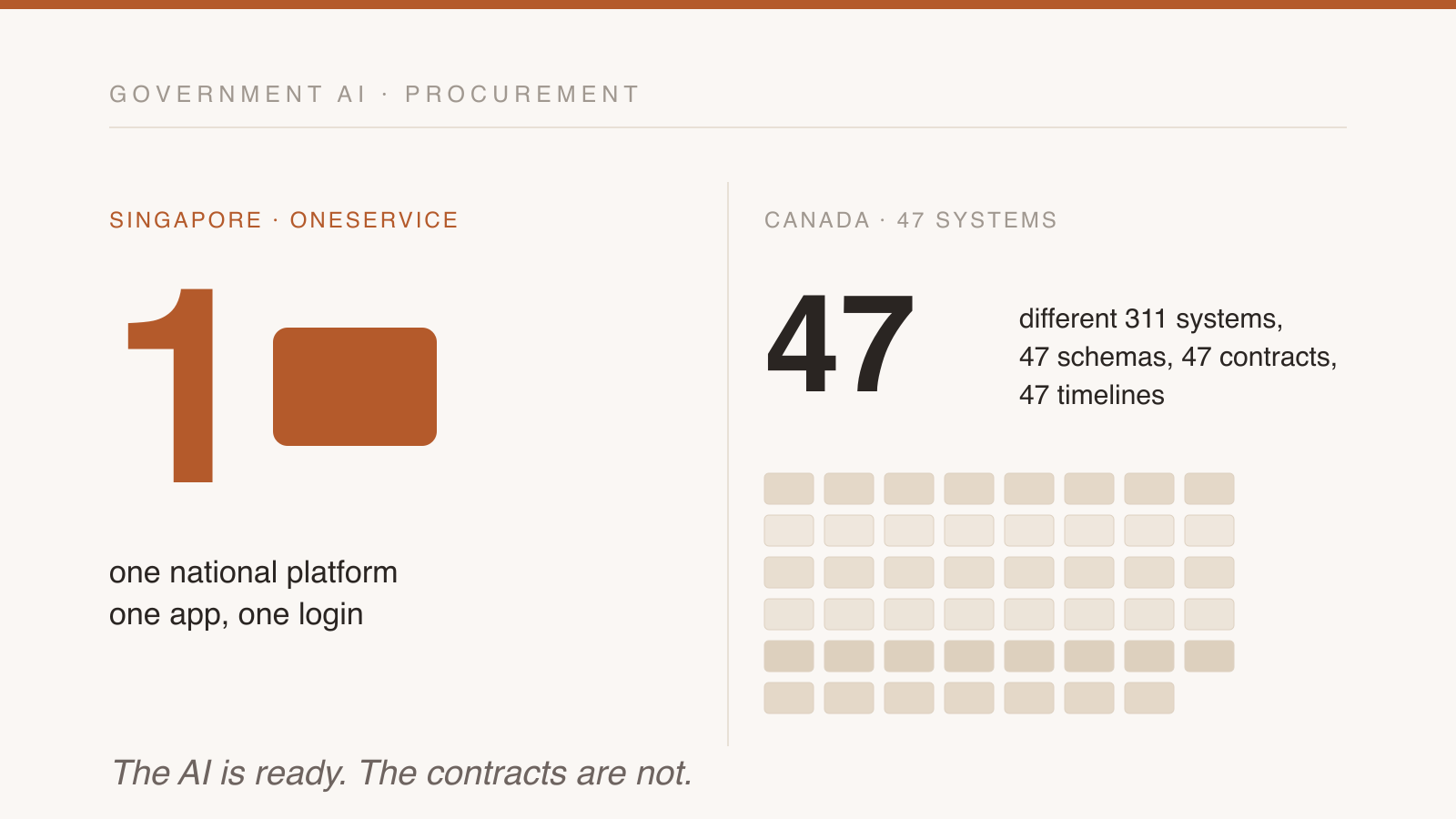
Canada decided the opposite, and it shows. We rank 47th for digital government, and not because our civil servants lack ambition or because the country is short on AI researchers. Toronto trained a real share of the people who built this field. The ranking is what happens when digital government gets executed as a stack of separate contracts, each with its own vendor, its own data schema, its own definition of what done means. The fifth city that wants to connect pays more than the first, because there is no system to connect to. There are only contracts. I have written before about why the gap was never resources, and procurement is where that gap lives.
AI makes this harder before it makes it easier. The US Government Accountability Office put out a report this year saying agencies are not collecting or applying the lessons from their own AI procurements. Every deployment behaves like the first one. The same mistakes come back, the same vendors win, and the same contract gets written the same way, fixed scope, full spec up front, success measured at delivery instead of at outcome. The knowledge that should pile up with each project evaporates between cycles.
The EU took the governance question seriously in a different way. It publishes model contractual clauses for buying AI, and its AI Act reserves the high-risk label for specific uses rather than for procurement as a category. An algorithm that scores vendor proposals and flags strange bids is a consequential tool, and it deserves human oversight, an audit trail, and transparency whether or not a regulation forces it. The rules are still catching up to where the tools already are.
The part that works looks nothing like the chatbots that get the headlines. Automated scoring of pass/fail criteria takes clerk work that was never worth a human day and turns it into two minutes. Reading qualitative proposals with one consistent process is fairer than rotating evaluator panels who each grade a little differently. Flagging a bid priced 40% under comparable submissions is worth doing. These work because they take friction out of a narrow task without pretending to replace judgment where judgment matters.
The deeper problem is that procurement was built to buy things, and an AI system is not a thing. A bridge is a fixed deliverable, finished the day it opens. An AI system that routes constituent inquiries is a process that keeps changing, needs retraining, and only shows whether it worked months after it shipped. A multi-year, fixed-scope contract awarded on price cannot hold that shape. It produces software that was current the day the contract was signed and old by the day it went live.
Canada’s “AI for All” strategy, launched June 4, names adoption as the gap. 12% of Canadian businesses use AI to make goods or services today, and the target is 60% by 2034. The strategy has the gap right, the same gap I traced from the other side in Canada has the talent, where the country trains this field and then watches the deployment happen elsewhere. What it does not say out loud is that procurement is the mechanism that either closes that gap or holds it open. A federal department does not adopt AI the way I install a library and start building. It issues a request for proposals, waits 18 months, and signs a five-year contract with a vendor whose technology is two generations old before the first user touches it.
The answer is not faster procurement. It is different procurement. Contracts that measure whether the service got better, not whether the software got delivered. Delivery written in iterations instead of one cliff at the end. Shared platforms where one city plugs into what another city already built, instead of paying for the same capability a dozen times at a dozen prices. Singapore built OneService as one national reporting platform, one app, one login, AI that routes your report to the right agency without you knowing which one it is. Canada runs 47 different 311 systems on 47 different schemas and 47 contracts that expire on 47 different timelines.
I build on the other side of that math. SolveTO already crosses city lines, one account that works whether you are in Toronto or the next city over, one platform instead of a separate product per city. The expensive part was deciding it should be one thing on day one. Adding a city after that is mostly configuration, not a fresh contract. I have written about what it takes to cross those lines and why Canada’s civic layer is a connection problem, and the same shape applies to government AI. The reuse only happens if the contract lets it.
The GAO finding is the cleanest evidence of where the problem sits. Agencies are not collecting the lessons from their own AI work. The configuration choices that failed, the vendor promises that did not hold, the user behavior nobody predicted, none of it reaches the next procurement. Each purchase starts from zero.
The technology does not need to get better for governments to use AI well. The AI is ready. The contracts are not, and the next five-year deal is being written the same old way right now, in some department that still believes the problem is the technology.
Be the first to comment
Thank you! Your comment will appear shortly, usually within a couple of minutes.
Something went wrong. Try again or contact me directly.