Canada's civic layer is one job away from done
Update, August 2026: the platform described here is now called Solve Canada, live in seven Canadian cities. SolveTO is the Toronto city brand within it.
Singapore built OneService and solved something Canada still hasn’t. One app, one login, one interface for every city in the country. A resident reports a pothole, a noisy site, a flooded drain, and the same flow finds the right agency every time. Move across the island and you don’t relearn anything, because the system was never built around one city to begin with.
I keep coming back to that, because it is the cleanest version of the thing I am trying to say. Singapore is not richer than Canada, not better staffed, not sitting on some piece of technology we can’t buy. The difference is not resources. The difference is that someone decided the civic layer should be one thing instead of a thousand.
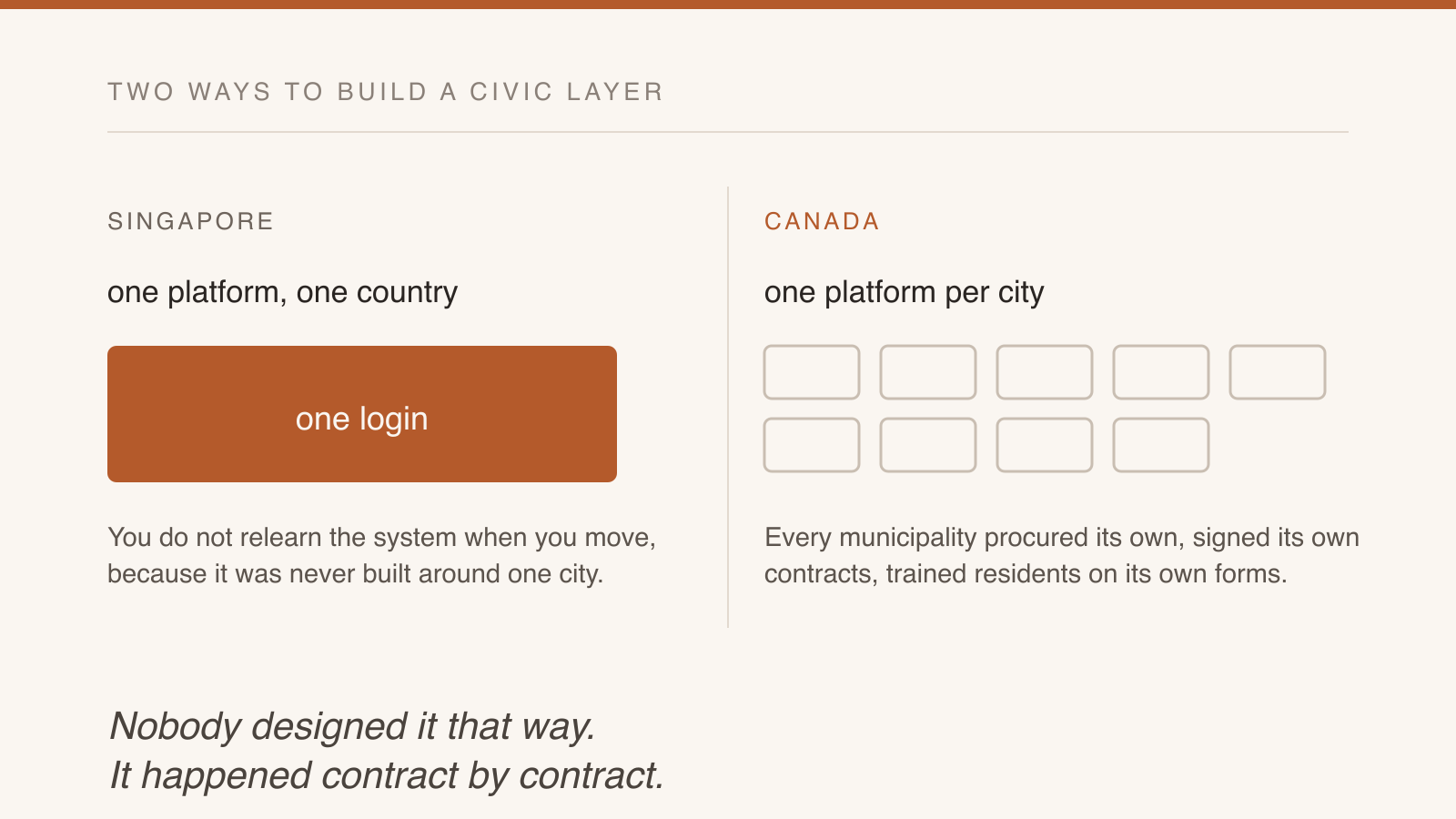
Canada took the other path, and not because anyone chose it. We arrived here by accumulation. Every municipality procured its own platform, signed its own vendor agreements, and trained its residents on its own forms. The result is a country where moving from one city to the next means starting over with a completely different system for the exact same broken curb.
Nobody designed it that way. It happened contract by contract, over decades of project-based thinking that funded launches but never funded scale. A grant pays to build a tool for one city. It does not pay to connect that tool to the next city, so nothing connects, and the resident is the one who pays for the seams.
I have lived inside those seams. I have reported a pothole in one city, learned the form, memorized the inbox, and then moved and watched all of it evaporate. The street was the same. The problem was the same. The only thing that changed was that I no longer knew who to tell, so eventually I stopped telling anyone. That is not apathy. That is friction doing exactly what friction does.
The mistake everyone makes is reading this as a money problem or a technology problem. It is neither. The tools to read a photo, route a report, and track it through to a fix have been sitting on the shelf, available to anyone, for years. What was missing was never the engineering. What was missing was the imagination to treat fifty cities as one problem instead of fifty.
So I built it that way from the start. SolveTO began with a single pothole in Toronto, but it was never a Toronto app. The login, the flow, the report history, the asset map underneath it, all of it was built to absorb the differences between cities so the resident never has to. When I extended it to the next city, the technical work was small. The strategic work, the deciding that this was one platform and not two, was the whole thing, and that decision was made on day one.
Today SolveTO tracks nearly a million pieces of public infrastructure across Toronto and Mississauga. One resident, one login, the same thirty-second flow on both sides of a municipal line that residents were told they could not cross. The platform already works across city lines. That part is done.
I want to be precise about what this is and what it isn’t. SolveTO does not replace 311, and it never has. It is the fastest front door to it. Every report a resident files still lands in the city’s own systems, with the crews who do the actual work, because those crews are doing the work and deserve the report cleanly and quickly. What SolveTO removes is the friction between seeing a problem and the city knowing about it, and the silence after, the loop that the old systems almost never close.
The cities themselves are starting to describe the same future I am already running. I have read the roadmaps: submit and track on your phone, smarter categories, a public map, closing the loop. The targets land in 2027. A plan for something that runs today is not a roadmap, it is a description of the present written as if it were the future. The technology was never the gap. The gap is who moves, and how fast.
That is the part I find hard to let go of. The benchmark exists. Singapore is not a thought experiment, it is a country that decided years ago that civic life deserved one front door, and then built it. Canada has the talent, the data, and now a platform that has already proven it crosses the lines everyone said it couldn’t. What is left is not invention. What is left is the decision to finish.
Picture it carried out. A resident moving from Toronto to Calgary keeps their report history. A student moving to Waterloo doesn’t learn a new system. A visitor in a city they don’t live in still reports the broken sidewalk they happened to walk past, because the platform doesn’t care where they pay rent. For the first time there is a live, national record of what is broken and how fast each place fixes it, sitting in the open instead of locked behind a records request and three months of waiting. Provinces see which cities keep failing their residents. Money follows the signal instead of the lobbying.
None of that requires Canada to become Singapore overnight, and it won’t. A top-down national platform is not coming here, our federation will not build it, and I have stopped waiting for it to. This gets built the way it has already started getting built, one place at a time, free for the public, paid for by the institutions that own the infrastructure, until the seams quietly disappear.
The civic layer Canada needs is not a thing we have to invent. It is a thing we have to connect. The platform already crosses city lines, and Canada’s civic layer just needs someone to finish the job.
Be the first to comment
Thank you! Your comment will appear shortly, usually within a couple of minutes.
Something went wrong. Try again or contact me directly.