Crossing city lines
Update, August 2026: the platform described here is now called Solve Canada, live in seven Canadian cities. SolveTO is the Toronto city brand within it.
There is a pothole I swerved for months on my street in Toronto, and the only reason I never reported it is that reporting it took longer than living with it. So in February I built a way to do it in about thirty seconds. You take a photo, the report writes itself, and it reaches the city and your councillor with the location and the details already filled in. I called it SolveTO and figured it was my own private annoyance.
It was not. Within weeks hundreds of Torontonians were using it, and the replies all said the same thing, people naming their own street and their own form they had given up on. Then people outside Toronto started asking when it was their turn.
That question turned out to be the whole story.
If you live in one city and work in another, you cross a line on the map every day without thinking about it. The pothole on Lakeshore West feels the same whether it sits in Toronto or in Mississauga. The broken streetlight outside the office does not care which municipality owns the bulb. The line means nothing while you are driving across it.
The line only matters the moment you decide to report any of it. In one city you find one form, one inbox, one process to remember. In the next city you find a different one, and most people never bother learning the second system, not because they stopped caring but because the first one already asked too much of them.
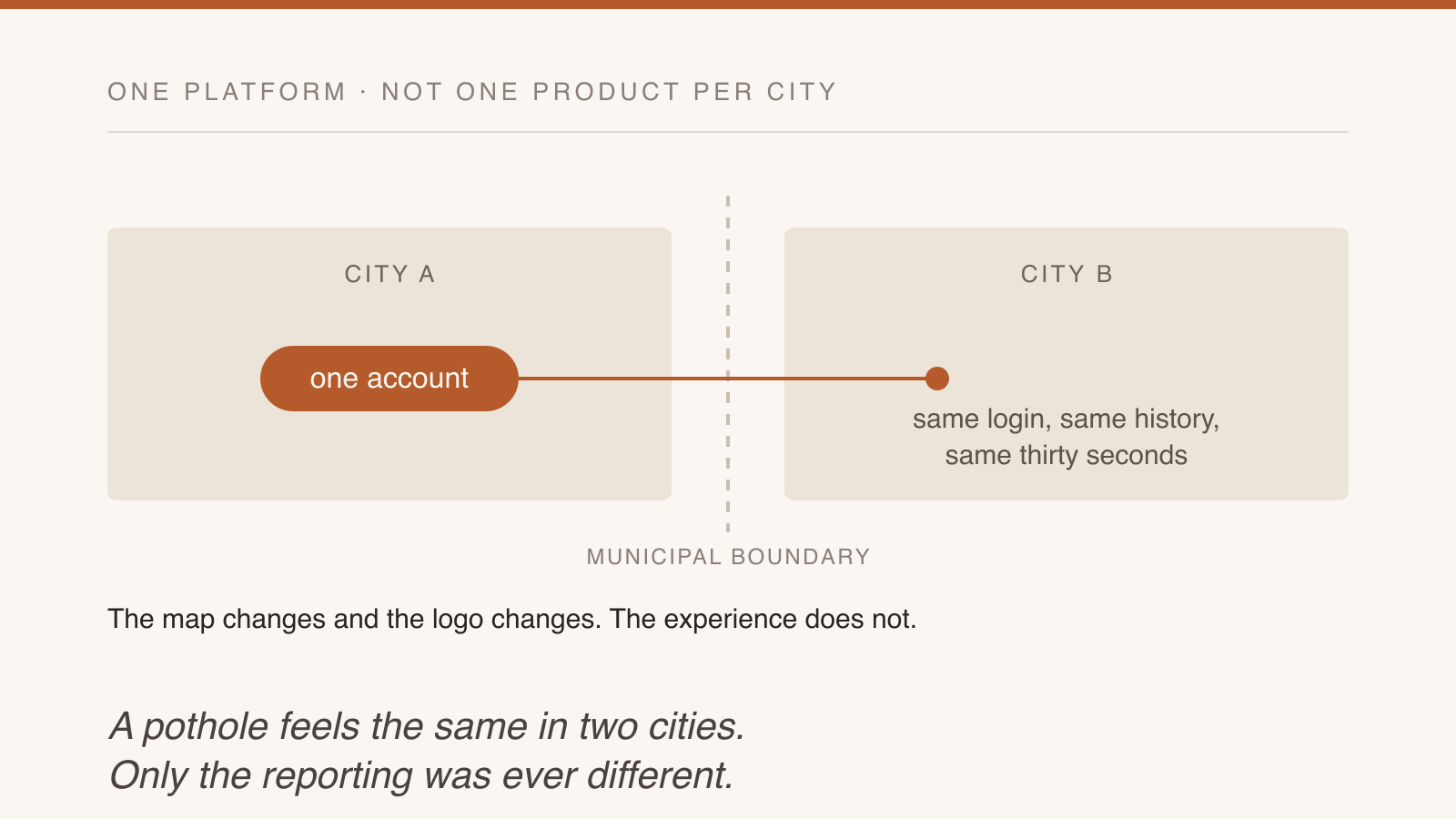
That is the part I refused to accept. So SolveTO went live in Mississauga as SolveSAUGA, and then in Milton as SolveMILTON, and none of them are separate products. They are one platform. One account works in every city, one login, one report history, one feed of what is near you. You switch cities in a dropdown and your reports follow you, your settings follow you, the map changes and the logo changes and the experience does not. A resident should never have to relearn how to report a problem just because they moved or drove across a town line on their way home.
Toronto proved the model. Mississauga proved it crosses a city line. Milton proved the part that was actually hard, which was never one more city. It was building one platform that does not start over every time a resident moves or a new town comes online. Milton came online knowing its own parks, its own schools, its own fire stations, its own streets on day one, so a resident there points at a place the system already understands instead of typing an address into a void.
Across all three cities the platform now tracks well over a million pieces of public infrastructure on one searchable map, all of it from public open data. That is the easy half of the work. The harder half is the half the city almost never finishes, and it is the same gap in every city I have launched in.
You report a broken thing. The city goes quiet. The thing stays open on your screen, and you are left wondering if anyone ever read it.
I lived this myself. A crack opened on College Street in April, I reported it, and the next time I walked past it was gone, fresh asphalt, patched. No email, no text, no word that anything had happened. The work got done and the report I filed sat there still open, like nobody ever saw it. So I marked it resolved by hand, my own report, one at a time. The crews are good and the city does the work, this is not a shot at the people patching the road. The gap is not the labour. The gap is that the one moment you actually care about, the it is done, you were heard moment, never reaches you.
When that moment never comes, you learn the lesson the system has been teaching you. Reporting things is pointless. So next time you say nothing.
There is a louder version of the same silence, where the city does not go quiet but tells you the job is done when it never was. I watched a Toronto report get stamped Completed the day after it was filed, with no inspection, no work scheduled, and a quiet handoff to someone else. The redirect was fine. The stamp was the problem. Completed on that screen is not a description, it is a metric, and the moment a handoff gets counted as Completed the close rate stops measuring things that got fixed and starts measuring things that got relabeled. A resident who reads Completed and then walks past the same broken trail a week later learns the same lesson the silence teaches, that the status is not the truth.
So that is the half of the problem the platform exists to hold, in every city at once. A report does not end when the city says so. It ends when the people who live there say so. Every report stays public, you can follow it as it moves, add a comment, and show with your own photo whether the thing actually got fixed. A single complaint is easy to lose. A street full of residents pointing at the same broken thing is a pattern, and a pattern is something a town has to answer for.
SolveTO complements 311, it does not replace it. The reports still go to the city, the crews still do the work, and when they do we say so and we mean it. What the platform adds is the part the system skips, the resident knowing they were heard and watching the thing get fixed, said out loud where everyone can read it.
A pothole is a pothole in a town of five thousand and a city of three million, which is why the same platform fits either one and every place between them. The map already crosses city lines and it was built to hold the rest of the country. The technical work is done. Whether a resident in any Canadian city gets to report a broken thing in thirty seconds, from the same account, and actually hear back when it is fixed, was never a technical problem. It is a choice, and I have already made mine.
Be the first to comment
Thank you! Your comment will appear shortly, usually within a couple of minutes.
Something went wrong. Try again or contact me directly.