Fly over your city and watch it look after itself
Update, August 2026: the platform described here is now called Solve Canada, live in seven Canadian cities. SolveTO is the Toronto city brand within it.
A city looks after itself in a thousand small acts nobody sees. A drain gets cleared. A burnt-out light comes back on. A pothole somebody reported on a Tuesday is gone by Friday. It happens around you all the time, and almost none of it is visible to the people it happens for.
I built something that makes it visible. It is called Pulse, and it is part of SolveTO, live now for Toronto and Mississauga. You sign in, and the city you walk through every day is sitting there in three dimensions, at night, rebuilt from its own public data and the reports residents have filed. Not a stock map with pins dropped on top. Your actual city, rendered as itself.
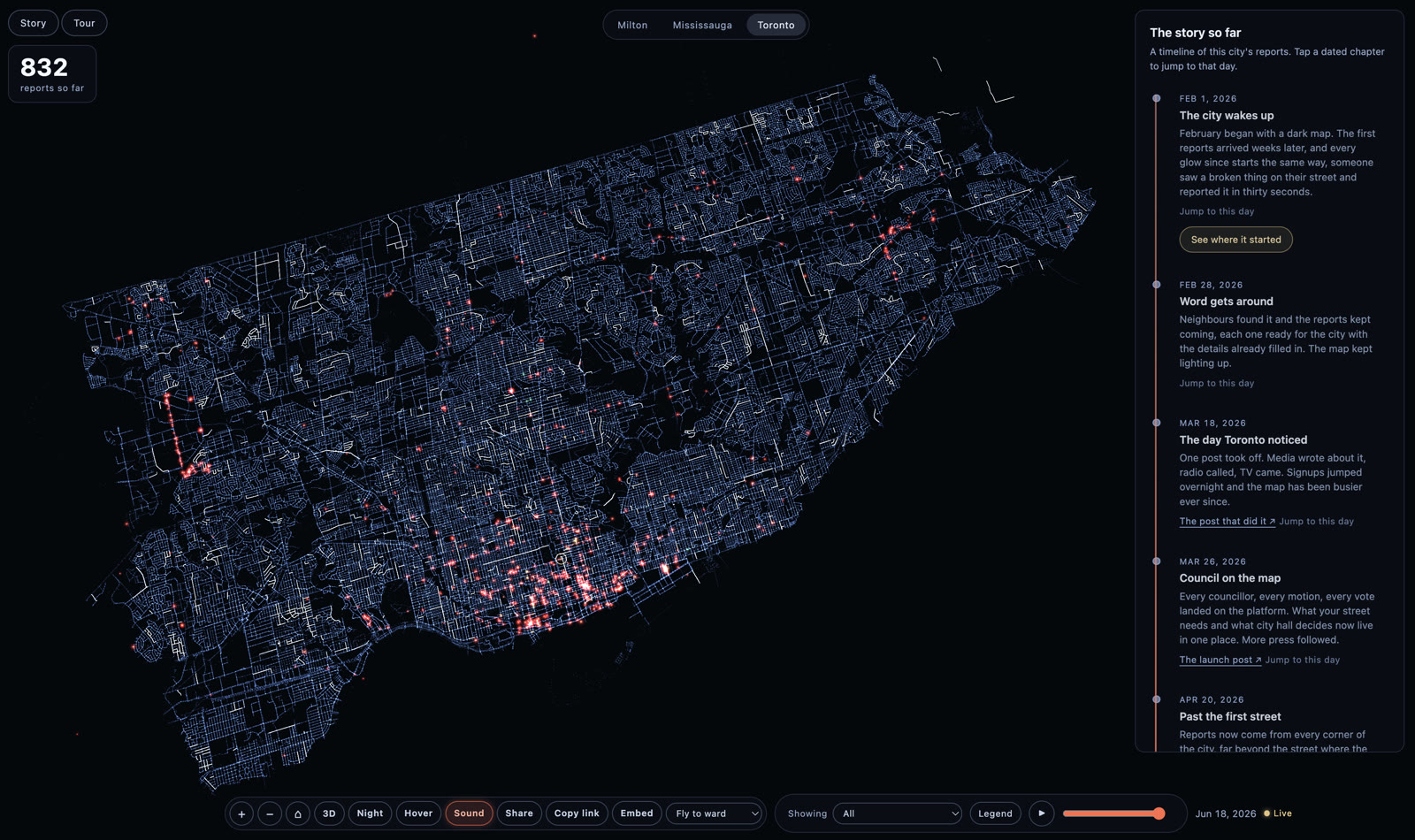
Then the reports arrive. Every issue residents have filed glows where it happened, and the map replays them through time. A street you know lights up. Then the one beside it. Then a corner across town you have never stood on, where somebody cared enough to report a problem you will never see in person. Weeks of civic life, compressed into something you can take in at a glance.
This is the part the old way of reporting was never built to show you. You file a report and it disappears into a system, and the work that follows happens in silence. Pulse turns that silence into something you can watch from above.
Take the controls
There is a guided tour that flies you through the city’s real story with sound. You sit back, and the city tells you what has been happening in it. Where the reports cluster. Where a season of residents paying attention actually looks like from a few hundred feet up. Get down low and the city is alive under you. Cars move along the streets you know. A red and white streetcar rolls past and you hear it rumble by. People are gathered where people actually gather, outside City Hall, down in the Distillery District, at the foot of the CN Tower.
I will admit the first time I flew it down over the lake toward downtown I did the Superman arms at my desk. The cape comes off fast, though, because what you are flying over is not a game. It is every problem your neighbours reported and every one the city went back and fixed.
I should be honest about the controls, because the experience is not identical everywhere. On a desktop you take the controls and fly it yourself, anywhere you want, as long as you want. On a phone the tour does the flying for you, and you can still drag to look around and pinch to zoom into the 3D city. The full hands-on flight is a desktop thing for now. The wonder is on the phone too. The cockpit is on the bigger screen.
When a report turns green
The reports do not just sit there glowing. They get fixed. When one does, the map throws a small celebration. The animation kicks in, a crew rolls up to the spot, the work happens, and a flag goes up where everyone flying past can see it. The city saying thank you, out loud, in lights.
The crews doing that work are doing real work, and a lot of the time it is not the city’s own staff. It is a contractor, a private company, someone who showed up and fixed the thing and almost never gets named for it. I want that to change. The flag that says a report was solved should be able to carry the name of whoever solved it.
That is the loop the old way never closed. You report a problem, and if you are lucky the problem goes away, but you rarely find out, and you almost never see who made it go away. On Pulse you watch the glow turn green, you see the flag go up, and the fix stops being a rumour. It becomes a thing that happened, in a place you recognize, that you can point at.
Why it had to be the real city
I could have shown all of this as a chart. Reports filed, reports closed, a line going up. Nobody flies over a chart. Nobody recognizes their own street in a bar graph, and recognition is the whole point. The map only works because it is your city. You find your street, you find the building you walk past every morning, and the glows stop being data and start being your neighbours.
A few buildings on the map carry a name. The Reference Library carries mine. When I put my name on a building I care about, the map stopped being a product I built and started being a neighbourhood I belong to. That is the feeling I am after for everyone who flies over it. A city that feels like yours instead of a place you happen to live.
What I am actually showing you
Reporting a problem is an act of faith. You send something into the city and you have to believe it lands somewhere, that someone reads it, that the street gets better because you bothered. Most of the time you never see the proof, so most people stop believing, and once they stop believing they stop reporting. The city then fixes what gets reported, and almost nothing gets reported, and you can see where that leaves your street.
Pulse is the proof. It is thousands of those small acts of faith lit up across a city that is quietly answering them. Not residents against the city, and not the city ignoring residents. A city and the people in it looking after the same streets, finally visible doing it together.
None of this replaces the report you file or the call you make to 311. Pulse sits alongside all of that and shows you what it adds up to. The reports still reach the city the same way they always did. The only new thing is that now you can stand above your whole city, watch the glows turn green one at a time, and know that some of them are green because of you.
Be the first to comment
Thank you! Your comment will appear shortly, usually within a couple of minutes.
Something went wrong. Try again or contact me directly.