Canada Has the Talent. The Talent Keeps Leaving.
Geoffrey Hinton did the foundational work behind this entire AI wave at the University of Toronto. The Vector Institute turned that work into a real concentration of talent. The researchers who came through those rooms went on to OpenAI, DeepMind, Google Brain, and the current run of AI startups, almost all of them headquartered in San Francisco. I build AI software in that same Toronto, and I watch the pattern up close every day. The talent is ours. The deployment is somewhere else.
On June 4 the federal government launched AI for All, $2.3 billion in funding and a target of 250,000 jobs by 2031. The same month, Cohere was valued at roughly $20 billion after merging with Germany’s Aleph Alpha, running about $240 million in annual recurring revenue from enterprise contracts in finance and healthcare. Cohere was founded in Toronto and stayed in Toronto. Two pieces of news from one month, and they point in opposite directions.
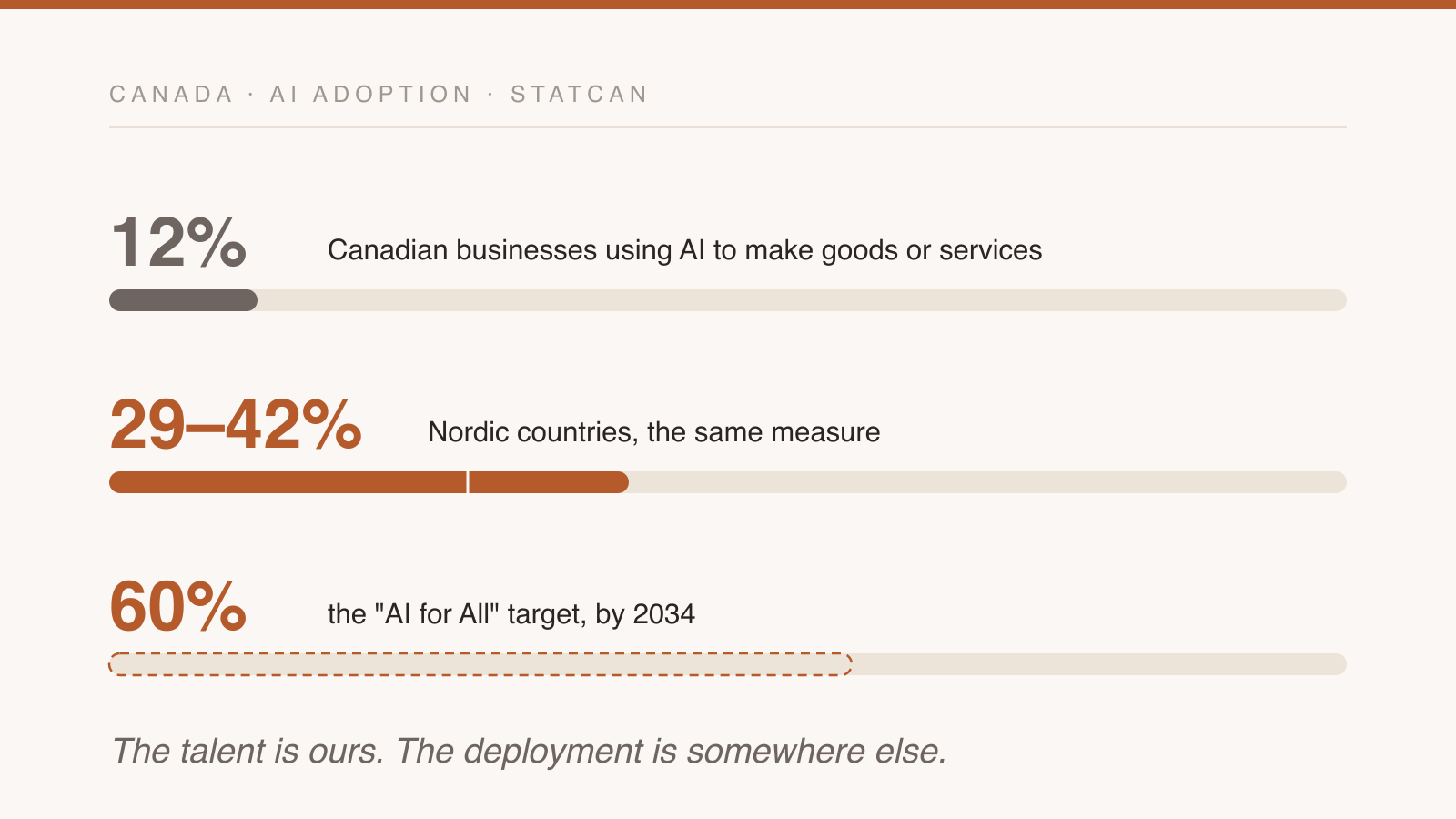
The number that actually describes where Canada stands is 12. Twelve percent of Canadian businesses used AI to produce goods or services between mid-2024 and mid-2025, by Statistics Canada’s count. In the Nordic countries the same figure runs between 29 and 42 percent. AI for All names that gap as the central problem and sets a target of 60 percent by 2034. It is much clearer about the number it wants than about what produces the gap or what would close it.
The easy story is talent drain, and it is half true. Canada trained the researchers and then exported them, and for years that was the whole explanation. But the drain has slowed, and Cohere is the counterexample standing in plain sight. A company can be founded here, headquartered here, and compete globally from here. What Cohere proves is that Canada can build AI companies. It does not prove that Canadian businesses are buying what those companies build. Those are two different problems, and the announcement treats them as one.
The real gap is commercialization capital. The weak stage was never seed, because the universities and the Vector Institute produce more early ideas than the country knows what to do with. The weak stage is growth, the Series B and C rounds that turn a working model into a deployed system at the scale enterprise contracts demand. That money has mostly come from American investors whose portfolio companies are American firms, so the working model gets built here and scaled there. The $500 million Canadian Tech Growth Fund inside AI for All is aimed at exactly this, but $500 million spread across a decade sits next to what a single institutional round puts into one company, and the comparison is not flattering.
The same arithmetic shows up in compute. The government committed $42.5 million to expand AI compute at the University of Toronto this year, which is real money for academic infrastructure and smaller than the annual compute budget of several individual labs. The line that Canada is committing over five years what the US spends in months is not a rhetorical flourish. It is arithmetic, and you can do it on a napkin.
What the high-adoption countries have is not a single announcement. It is an accumulation: compute at enterprise scale, government departments that run AI in their own operations and publish what they learned, and procurement that lets a small company build for a city without surviving a five-year vendor-qualification process first. I have run straight into that last one. I built SolveTO to cross city lines from the first day, and the platform already does, but the structure that funds civic software still pays each city to buy its own version and re-train its own staff. The gap there was never resources, and it was never collection either. It was the decision to connect what already exists, the same decision Canada keeps not making at the national level.
Canada holds two things most countries would want. It has a research tradition that is genuine and durable, the lineage from Hinton through Yoshua Bengio and the institutions they built. And it has a multilingual, multicultural workforce that looks like the actual population enterprise AI has to serve. Both are real advantages. Neither one closes an adoption gap on its own, because adoption is downstream of trust and procurement and a customer willing to sign, not downstream of who trained the model.
The critics of AI for All landed on the right fault lines. The budget math is contested, somewhere between $2 billion in fresh money and $8 billion once prior commitments are folded in. There is no clear accountability for the workers a fast rollout displaces. And a jump to 60 percent adoption by 2034 asks for an enormous change in enterprise behaviour that a press release can name but cannot cause. The strategy is pointing at the right problem. Everything that matters is in the delivery.
Adoption does not follow an announcement, and trust cannot be ordered. Every year of slow procurement and hesitant enterprise deployment hands ground to the companies that deployed first, and that ground gets more expensive to take back as their systems harden into the way things are done. The question was never whether Canada can build AI companies, because Cohere already answered it. The question is whether Canadian businesses will run AI-built systems by the end of the decade, or keep buying American systems through American contracts, paying in American dollars, while the talent that built them lives in Toronto.
Be the first to comment
Thank you! Your comment will appear shortly, usually within a couple of minutes.
Something went wrong. Try again or contact me directly.