Volume Is the Only Lever
A post about a pothole took off while I was writing code and not looking at my phone. The first interview requests arrived that week, and within two days the story had run on CBC, Global, and a national radio show while reports came in from wards I had never set foot in. For about ten days the work had more momentum than I knew what to do with, and then I did what builders do, which is go back to the thing I was building. I stayed there for months. The product got better. Almost nothing else moved.
That was the lesson sitting in front of me the entire time and it took me until July to take it seriously. The work moves when it is loud. When it is quiet, it is still good work, and it is happening in a drawer.
I want to be precise about why this is not a marketing observation. I cannot outspend anyone in this space. There is no ad budget, no sales team, no partnerships department, and the systems I am building against move on multi-year procurement cycles. Against that, the one input I control without asking permission is how much visible work I produce and how many rooms I walk into. Volume is not a tactic I chose from a list. It is the only distribution channel priced in time instead of money, which makes it the only one available to me.
So two weeks ago I went loud on purpose, with a great deal more to show than I had the first time.
Fourteen days produced the thing I had been building toward since the start: in Toronto, a resident’s report now carries its whole story on one public page, including the moment the city marks the work complete, checked against the city’s own records. Because “complete” is the city’s word rather than the resident’s, the page then asks whether it is fixed or still there, and the person who reported it gets the final say. Toronto’s Auditor General first asked for outcome tracking in 2011. Somewhere in the middle of those two weeks the platform passed a thousand resident reports across seven Ontario cities, sitting on top of more than two million mapped pieces of public infrastructure. Getting there meant crossing city lines first, which was the hard part, and every city after the second has been a variation on a problem I had already solved.
Then the noise, and what came back through it. A former mayor spent eight minutes with me on Newstalk 1010 and described the missing piece before I had said a word, which is also where I made a mistake I had to correct in public. CTV Kitchener covered the platform inside a story about a repair residents had been waiting on for months. MiltonToday told its readers that reporting local issues just got easier. I published an open letter, a media kit, a full build timeline, and a newsletter. I gave a talk at Civic Tech Toronto about how one pothole turned into a reporting platform for any Canadian city, and I am arranging talks in two more cities now.
The louder half of those two weeks never got broadcast. I wrote to councillors in all seven cities to show them what their residents now have, and sat down with a few of them. I reached out to the BIA managers whose strips this helps most, to residents’ associations, and to people inside companies and public services who live with the same broken streets and had never had a record of them. That part was email, phone calls, and coffee, and it produced more than the radio did. It also looks like nothing from the outside, which is why the people who only ship tend to skip it.
None of that was the surprising part. The surprising part was who arrived. A professor. Executives at companies whose names you would recognize, some with congratulations and some with questions I am still thinking about. Residents in cities I have not launched in, asking when their turn comes. A stranger in Waterloo who knew exactly who I should be talking to and made the introduction without being asked.
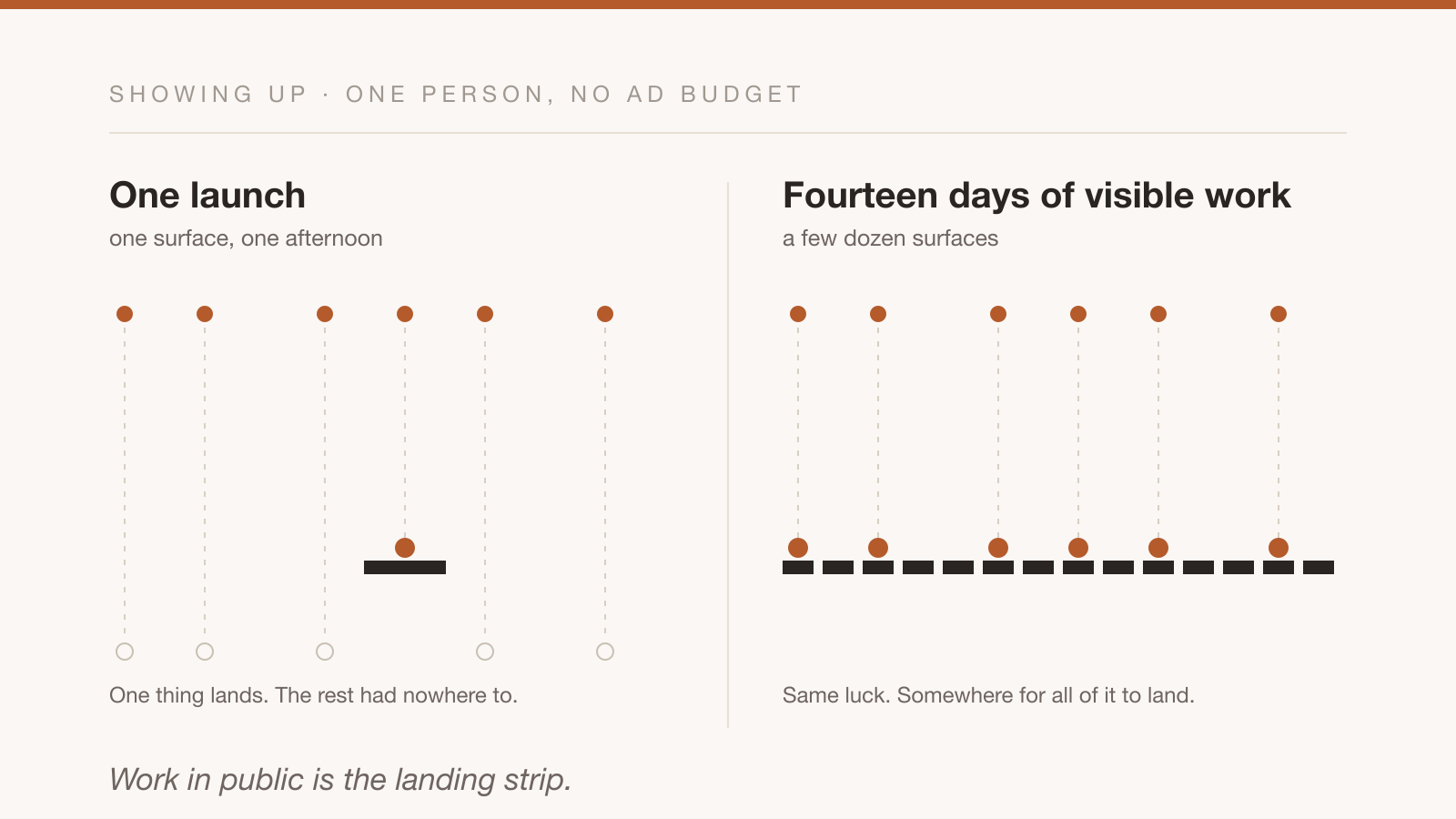
I did not plan a single one of those, and I could not have. That is the mechanism, and it is the reason volume compounds while a single big launch does not. Luck needs somewhere to land. Every visible piece of work is another surface it can land on, and the only variable you control is how many surfaces exist. One launch gives it one target on one afternoon. Fourteen days of shipping and writing and showing up gives it a few dozen, spread across enough time that different people encounter it in different moods for different reasons.
The cost is a thick skin, and this is the part nobody puts in the retrospective. Attention delivers pushback and applause on the same afternoon, from people with equal confidence and unequal information, and you have to be able to take both without adjusting course for either. I wrote about that after the talk, about how obsession and stubbornness are the whole game, and two loud weeks confirmed it harder than the talk did. Believe the idea. Hold it while reasonable people tell you to soften it.
There is a version of me that spent those two weeks heads-down instead, and that version shipped roughly the same features. He is a few months behind on everything else, and he does not know it, because a quiet month and a loud month feel identical from inside the editor.
Work in public is the landing strip. Nothing lands on a runway you have not built, and the builders wondering why their good product is not moving are almost always wondering it from somewhere nobody can see.
Be the first to comment
Thank you! Your comment will appear shortly, usually within a couple of minutes.
Something went wrong. Try again or contact me directly.