Week one: SolveTO launched, and the city noticed
I launched SolveTO ten days ago expecting a quiet first week, the kind where you watch a few friends try the thing and then you go back to fixing the parts that break. That is not what happened. Reports started coming in from wards I had never set foot in, residents I had never met sending photos of potholes and broken sidewalks and storm drains nobody had bothered to report before. By the end of the week the count sat at sixty-seven reports across twenty wards, and three of those were already confirmed fixed by the people who live near them.
The pattern underneath those numbers is the whole reason I built this. Reporting an issue to the city the official way takes five pages and twenty-something form fields, and most people do not have that kind of time for a pothole they have already learned to swerve around. So they walk past it, the city fixes what gets reported, and almost nothing gets reported. SolveTO turns a new report into a thirty-second job and adding your voice to an existing one into fifteen seconds. Give people a faster door and they walk through it, no ads, no pitch, just a process that did not cost them their afternoon.
Then the media week arrived, and it arrived all at once. In two days the story ran on CBC Metro Morning, Global News at six, NOW Toronto, Toronto Today, and a national radio show that carries across Corus stations from Calgary to Vancouver. Every interviewer asked me the same question in the same skeptical tone: why not just use 311? My answer never changed. SolveTO complements 311, it does not replace it. The crews doing the actual repairs are doing real work, and the city wants the reports too. The problem was never the city’s willingness to fix things, it was the friction sitting between a resident and the moment they could tell anyone at all.
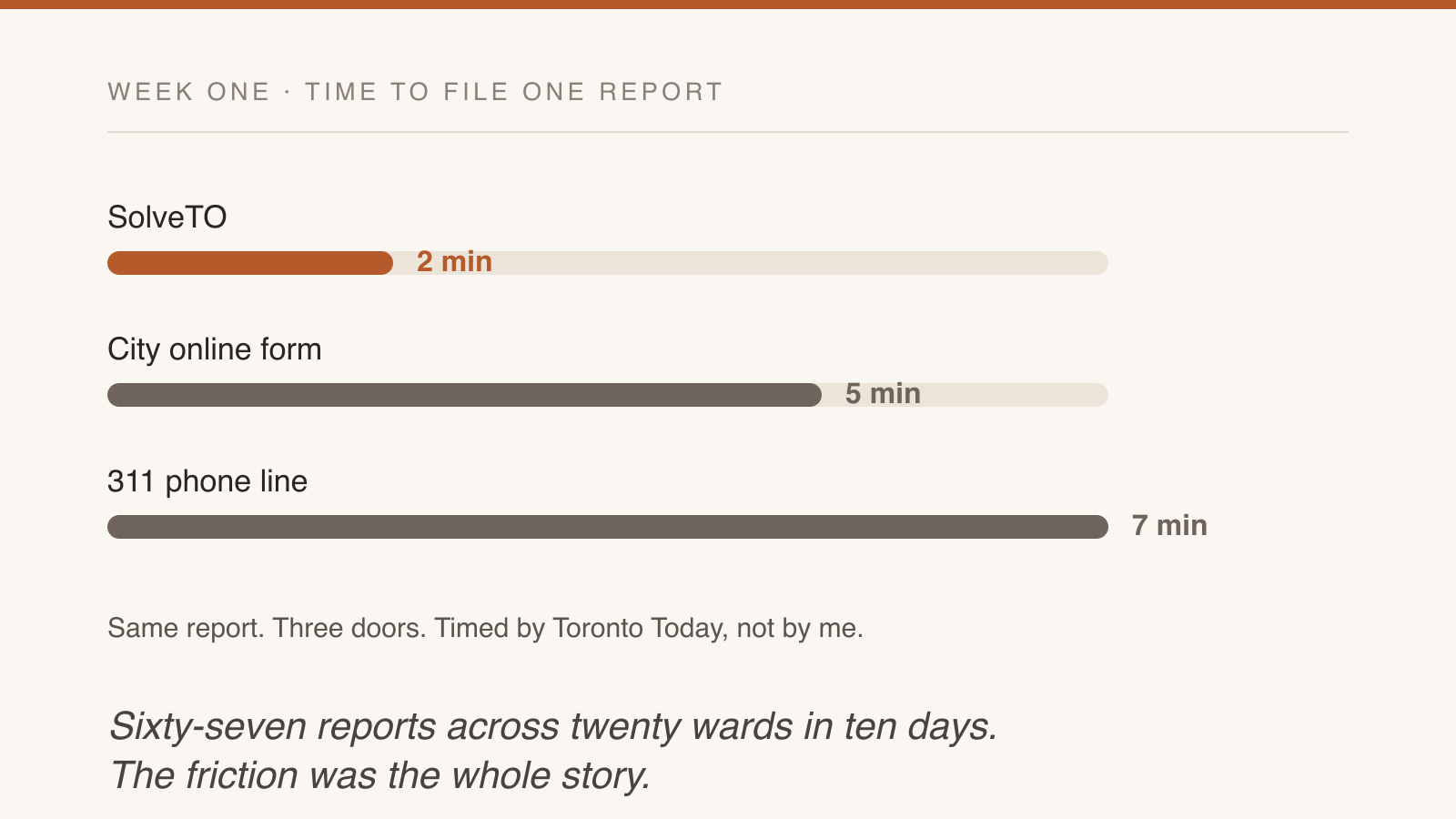
Toronto Today did the most useful thing of anyone that week. They ran their own test instead of taking my word for it, timing the same report through SolveTO, through the city’s online form, and through the 311 phone line. SolveTO took two minutes, the form took five, the phone took seven. That comparison did more for the argument than anything I could have said into a microphone, because it was theirs, not mine.
The question I could not answer cleanly during those interviews sent me down a different path entirely. People kept asking what happens after a report leaves SolveTO, and whether the city sends back a case number you can track. So I spent a day testing every major Canadian city’s reporting API, looking for one, just one, that would let me submit a request and get a reference back. I found zero. Toronto’s was retired and now returns an error. Ottawa’s server is simply gone. Quebec City’s security certificate expired. Most cities never built one at all and run everything through an app or a phone tree. The civic reporting layer of an entire country is, for the most part, still running on email.
That changes who is responsible for closing the loop. If the city does not report back when something is fixed, then the only people who can confirm it are the residents standing in front of it. That is exactly how community verification has worked elsewhere for nearly two decades, and it is how those three fixed reports got marked fixed this week. One pothole went from reported, to orange spray paint within a day, to fully repaired within two, with the before-and-after sitting right on the report page for anyone to see. Nobody at city hall told me. A neighbour did.
But verification needs something to hold onto, and that is the gap the API research forced me to close. If I cannot hand you a city case number, I can at least hand you mine. So every report now gets its own reference, something like STO-A3F7K2, generated the moment you file it and yours permanently. You click Track in the header, paste it in, and your report comes up with its photo, status, and timeline. I am careful to say what it is and what it is not: it is a SolveTO identifier, not a City of Toronto case number, and if the city ever starts handing out their own, I will show both side by side. Login is still required to file, but the reference travels with you and you can share it with a neighbour or your councillor without anyone logging in to see it.
That is the thread the whole week kept pulling on. The reports proved people will act when the door is easy. The coverage proved the frustration was never just mine. The API search proved no city is going to close the loop for us yet. And the reference number is the smallest honest thing I could build to start closing it ourselves. The media attention brought people in, but the day after CBC I was back writing code, because attention validates an idea and only the product keeps earning it. Week one did not prove SolveTO works forever. It proved the friction was the whole story, and that the moment you remove it, a city full of people who supposedly do not care turns out to care quite a lot.
Be the first to comment
Thank you! Your comment will appear shortly, usually within a couple of minutes.
Something went wrong. Try again or contact me directly.